Saturday, 15 August 2015

10 Nutritional Guidelines For Filipinos


1. Eat a variety of foods everyday.
  • The human body needs more than 40 different nutrients for good health. No single food can provide all the nutrients in the amounts needed. Eat a variety of foods, to provide all the nutrients required in the proper amount and balance.
2. Breast-feed infants exclusively from birth to 4-6 months and then, give appropriate foods while continuing breast-feeding.
  • Infants and children up to 2 years of age are most vulnerable to malnutrition. Breast-feeding is one of the most effective strategies to improve child survival. Nutritional requirements of an infant can be obtained solely from breast milk for the first 6 months of life. After that time, breast milk must be complemented with appropriate foods, but breast-feeding should be continued for up to 2 years of age or longer. 
  • The decision to breast-feed is made by the mother. Nonetheless, the husband and other family members, health workers, neighbors, community organizations, officemates and employers must encourage her to breast-feed her infant.
3. Maintain children's normal growth through proper diet and monitor their growth regularly.
4. Consume fish, lean meat, poultry or dried beans.
  • To improve the Filipino diet, not only should the total quantity of food be increased but the quality of the diet should also be improved by including animal products of substitutes.
  • Including fish, lean meat, poultry, or dried beans in the daily meals will not only enhance the protein quality if the diet but also supply highly absorbable iron, preformed vitamin A and zinc.
  • Fish, lean meat, poultry without skin, and dried beans, in contrast to fatty meats, are low in saturated fats, which are linked to heart disease.
5. Eat more vegetables, fruits and root crops.
  • In general, most people do not eat enough vegetables, fruits and root crops. Results of food consumption surveys conducted by the FNRI show that the average consumption of green leafy vegetables, vitamin C-rich fruits and root crops are low in the Filipino diet.
  • The consumption of more vegetables, fruits and root crops is encouraged to help correct the micronutrient deficiencies consistently noted in national nutrition surveys. Eating root crops will add dietary energy to the meal.
6. Eat foods cooked in edible/cooking oil daily.
  • In general, Filipinos use very little oil in their cooking. Boiling is the most common method of food preparation. Hence, the total fat and oil consumption in a Filipino diet is low.
  • Fats and oils are concentrated sources of energy. A low fat and oil consumption results in a diet low in energy value, contributing to chronic energy deficiency. Fats and oils are also essential for absorption and utilization of fat-soluble vitamins, such as vitamin A. A low fat intake may be one of the causes of vitamin A deficiency among Filipinos.
  • To ensure adequate fat intake, Filipinos should be encouraged to stir-fry foods in vegetable oil or to add fats and oils whenever possible in food preparation. This will guard against chronic energy deficiency and help to lower the risk of vitamin A deficiency.
  • The excessive use of saturated fats and oils, however, may increase the risk of heart disease. The proper choice of fats and oils therefore is essential.
7. Consume milk, milk products and other calcium-rich foods such as small fish and dark green leafy vegetables everyday.
  • Nutrition surveys indicate a consistent failure of Filipinos to meet dietary recommendations for calcium. An adequate amount of calcium in the diet starting from childhood all through adulthood will help prevent osteoporosis in later life.
  • Milk and milk products provide highly absorbable calcium besides being good sources of protein, vitamin A and other nutrients.
  • Milk and other calcium-rich foods are valuable additions to our rice/plant-based diets, which are not only poor sources of calcium but also contain calcium-inhibiting substances.
8. Use iodized salt, but avoid excessive intake of salty foods.
  • Goiter and Iodine Deficiency Disorders are rampant in many areas of the Philippines, causing physical and mental retardation in children. The regular use of iodized salt in the table and in cooking in addition to taking iodine-rich foods, will greatly help in eradicating this preventable disease.
  • On the other hand, excessive intake of salt and salty foods particularly in susceptible individuals increases the risk of hypertension and hence of heart disease. Avoiding too much table salt and overly salty foods may help in the prevention and control of these conditions.
9. Eat clean and safe food.
  • Food and water are essential to life but they may also carry disease-causing organisms like bacteria, viruses, fungi and parasites, or harmful chemical substances.
  • It is important to buy foods that are safe. Purchase food only from reliable sources. In addition, care must be taken when preparing and serving meals to prevent food-borne diseases.
  • Sharing in the efforts to improve environmental hygiene and sanitation in the community will greatly contribute to food safety in the home.
10. For a healthy lifestyle and good nutrition, exercise regularly, do not smoke and avoid drinking alcoholic beverages.
  • With the changing lifestyle of Filipinos, chronic degenerative diseases are becoming significant public health problems. Healthy diets, regular exercise, abstinence from smoking and moderate alcohol intake are key components of a healthy lifestyle.


reference: http://www.nscb.gov.ph/headlines/nutrition/ngf.htm


  • An adequate diet for an active child is one that promotes good health and normal growth.
  • A well-nourished child is healthy, strong, and alert, has good disposition, and grows at a normal rate.
  • A poorly nourished child exhibits sluggish if not permanently delayed physical and mental development. In addition, he is lethargic and frequently ill because of low resistance to infection.
  • Over nutrition on the other hand, may lead to obesity that may cause physical and emotional problems in childhood and later in life.

Saturday, 20 June 2015

Physical Changes during Puberty

Most of us know these signs of puberty like hair growing in private areas, the monthly period a girls, increasing body odor of teens, changing or deepening of voice in boys, breast development in girls and many others. We should be knowledgeable and understand these series of changes happening to teenagers during puberty
Usually after a girl's 8th birthday or after a boy turns 9 or 10, puberty begins when an area of the brain called the hypothalamus starts to release gonadotropin-releasing hormone (GnRH). When GnRH travels to the pituitary gland (a small gland under the brain that produces hormones that control other glands throughout the body), it releases two more puberty hormones — luteinizing hormone (LH) and follicle-stimulating hormone FSH). [1]

What happens next depends on gender:

These are some of the general changes that happen to adolescent boys
and girls during puberty:


• There is a rapid increase in height and weight. Boys experience this usually two years later than girls. The head, hands and feet grow faster first, then the arms and legs, and then the chest and shoulders. This is why the body of an adolescent seems to be out of proportion.


• Changes in circulatory and respiratory systems—The lungs and heart work better, so the teenagers become stronger and can work longer, although the increase is more in boys than in girls.


• Body composition—Muscles develop rapidly, although boys’ muscles grow faster than girls’. Body fat increases, although the increase in girls’ body fat is more than the boys’. 


usually boys and girls get fat at this stage. In girls, fat usually accumulates inside the breast and hips which is very evident during the process. For the boys body fat increase as making bigger than before.

• Other changes:
o Increase in hormone production.
o Harder bones
o More active sweat glands

Primary sex characteristics are changes directly related to sexual
reproduction.
The reproductive organs of both boys and girls grow and develop. The boys
experience their first release of seminal fluid or ejaculation from the penis. The
girls experience menarche or the first release of blood and fluids from the vagina,
later called menstruation.


Secondary sex characteristics are changes not directly related to sexual
reproduction.


Boys
• deeper voice
• bigger 
Adam’s apple
• shoulders become wider than the hips.
• face, body and pubic area hair growth
• skin on the upper arms and thighs becomes rough.


Girls
• development of breast
• hips become wider than the shoulders.
• underarm and pubic area hair


1. http://kidshealth.org/parent/growth/growing/understanding_puberty.html#
2. Grade 7 Leaners' Manual pp 20 - 21

Stages of growth and development


  • Growth is a lifelong process that starts with a single cell. It’s created by joining together of one special cell with another cell which comes from each parent.• The period of life from the first year through the teen years is a time of great growth.

  • Different stages of growth.• There are stages of growth that a person goes through.• Infancy• Early childhood• Childhood• Late childhood• Adolescence• adulthood
  • Infancy• Infancy- from birth to 18th months• Physical changes• Bones are still soft and flexible• Learns to sit, to crawl, to stand and to sit.• Mental changes• Gets what it need by crying• Can recognize parents and siblings


  • Early childhood• 18th month to 3 years• Physical changes• Learns to walk and to talk• Arms and legs get longer• Mental changes• Learns to use the toilet• Social changes• Not ready to share or to play interactively with others

  • Childhood• 3 to 6 years• Physical changes• Begins to lose milk teeth• Mental changes• Learns to behave while in a group• Social changes• Learns to play interactively and to make friends• Emotional changes• Physical contact becomes less frequent

  • Late childhood• Physical changes• Appetite increases• Process of sexual maturity begins• Mental changes• Acquires high-level thinking skills• Emotional changes• Self-centeredness lessens• Choose friends of the same sex

  • Adolescence• The period of gradual change from childhood to adulthood the time of life between childhood and adulthood.• Physical changes• Rapid physical growth• Body starts to look more like an adult• Mental changes• Begins to question oneself• Starts to enjoy participating in adult conversationEmotional changes• Feeling very quickly from being happy to being lonely.• Sees people as having needs like his.• Social changes• Friends views become more important


  • Adulthood• Period from the twenties onward• Physical changes• A slow weakening of the five senses• a slow loss of calcium in the bones• Bones become brittle• Stiffening of the joints and weakening of the muscles


http://www.slideshare.net/AudricTuppil/stages-of-growth-and-development

Monday, 15 June 2015

Dimensions of Holistic Health

Propelling_________________________________________________________

The best way to live a long life is to get serious ailment and take care of it. - Sir Wm. Osler, MD

What is health?

The word health came from the Anglo-Saxon root "helthe", which means "hale, sound, whole".

The World Health Organization (WHO) defines health as a "state of complete physical, mental, and social well-being and not merely the absence of disease or infirmity".

A person "in perfect health" my suddenly seen unhealthy if he or she is confronted with a new job or situation that demands upon him/her not previously encountered. One may be physically strong and able to cope with physical hardships but he may be unhealthy as shown by his behavior.

Signs of good health

>healthy teeth
>fast healing wounds
>clear vision and hearing
>soft, flawless skin
>shiny hair
>happy disposition
>positive outlook in life
>can handle stress well
>full of energy in all activities
>can face life's trials and difficulties

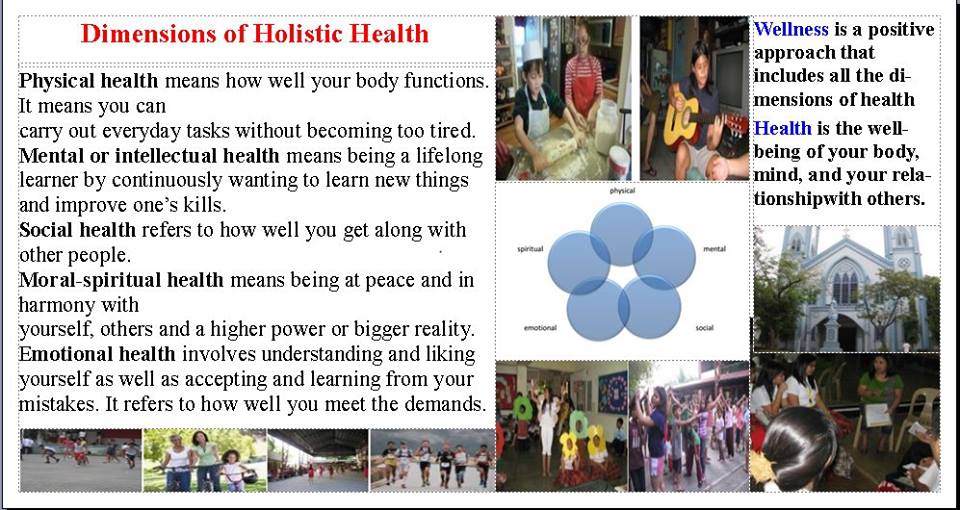
Health focuses on wellness. It is a positive approach that includes all the dimensions of health: physical, mental, emotional, social and moral-spiritual. 

Health is the well-being of your body, mind, and your relationship with others. On the other hand, wellness means striving to live your life to achieve your fullest potential, making decisions, and acting in healthy ways. It is practicing positive health behaviors based on sound knowledge and healthy attitudes. You are likely to have a high degree of wellness if you have a balanced life. Being healthy means having a balance of the dimensions of health. This results in attaining holistic health.

Guide Questions:

What is holistic health?
Why is it important for us to know the dimensions of health?
How can we achieve holistic health?

What is Holistic health? 
- Lonny J. Brown, Ph. D.

Taking into description one's body, mind, emotions, and spiritual life, holistic health combines the best of modern scientific diagnosis and monitoring techniques with both ancient and new health promotion methods. These include natural diet and herbal remedies, nutritional supplements, exercise, relaxation, psycho-spiritual counselling, medication, breathing exercises and self-regulatory practices. It addresses not only symptoms, but the entire person, and his or her current life dilema, including family, job, and religious life. It emphasizes prevention, health maintenance, high-level wellness, and strength. It views the client as an participant in the healing process, rather than simply a passive recipient of health care.


Dimensions of Holistic Health


1. Mental health – challenge yourself: ask questions, be open to new ideas, learn new skill, be imaginative and do interesting mental activities these help us to have a healthy and young at mind
means being a lifelong learner by continuously wanting to learn new things and improve one’s kills. A mentally healthy person is open to new ideas and experiences that can improve personal,
family, and community life.

learning new skills to improve personal and family life

2. Moral-spiritual – spiritual wholeness is an important contributor to good health, it brings harmony, focus, direction, and balance to our lives. This principle in which we believe drives the essence of our being

1. Telling the truth and showing respect are commonly accepted standards of right behaviour.
2. Seeking guidance from parents, teachers, religious leaders, and other responsible adults will help you in making difficult choices.

3.Act according to a set of high ethical principles. 

You will gain respect and trust from others if you demonstrate good character. Moral-spiritual health, together with the other dimensions, will help you attain holistic health.

3. Social –refers to how well you get along with other people. This can be observed when you as a member of the community, being well-integrated encourage personal growth. A supportive social network also contributes to emotional health, happiness and helps us make healthier choices
a. make and keep friends
b.  play/work well with a group
c. give and get help from others when needed
d. communicate well and show respect and care for yourself and others

4. Physical – best physical health occurs when our bodies are functioning at their highest potential. This results from healthy habits such as good nutrition, an active lifestyle, regular sleep pattern, and avoiding harmful habits such as smoking, drug use, or heavy drinking
means how well your body functions. It means you can carry out everyday tasks without becoming too tired. It also means you have enough energy to enjoy activities and to meet emergencies. It means developing healthful habits and avoiding destructive habits, such as smoking, drinking alcoholic beverages and taking dangerous drugs and harmful substances.

a. keeping your body fit by exercising and participating in active games
b. eating a well-balanced diet
c. getting adequate sleep and rest
d. drinking enough water
e. practicing cleanliness and good grooming habits
f. getting regular medical and dental checkup and treatment
g. avoiding harmful substances, such as tobacco, alcohol and drugs of abuse

5. Emotional health involves understanding and liking yourself as well as accepting and learning from your mistakes. It refers to how well you meet the demands of daily life and how you adjust to new situations. It also means
expressing your happiness, love, joy and hope as well as your sadness, anger, stress and fear in healthful productive ways. You can best practice these when you:
a. face life’s problems squarely
b. handle stress and seek help, if needed
c. express your emotions in positive ways
d. deal with life’s pressures and stresses in positive ways
 e. build strong communication network among family, friends and peers 

JOURNEY TO HEALTH AND WELLNESS

Wellness starts with you, your choices in choosing to live a quality life. The following is a helpful guide  in journey to health and wellness

1. Schedule a Me-Time  -a quite personal time
2. Do the things you enjoy most - nuture yourself by doing the things you love to do most
3. Get enough sleep - is important to health
4. Keep your feet moving - exercise
5. Mindful eating - review eating habits
6. Leave the work in the workplace - allow yourself to enjoy simple moments doing ordinary things like laundry, reading, or drinking coffee or eating a healthy meal without being disturbed
7. Say "NO", when you have to - create space in your life for moments that bring joy and so say no when you have to
8. Relaxing day off - be sure not to engage work
9. Bonding with the family- use family time to create good family memories
10. One on One bonding -  

TIME FOR FRIENDS is a wonderful avenue to have fun, expand your world and laugh over silly escapades


take this holistic health exam

https://www.expandinglight.org/holistic-health/self-assessment-quiz.php

MAPEH on the Go, revised, Muyot, Fritzimarie R., Baarde, Claire G., and Pastor, Esmeralda V., Sunshine                         Interlinks Publishing House, Inc. Quezon City Philippines

Journey towards MAPEH 7
register and see how your overall health is

source: Journey through MAPEH 7 k-12

Changes in the health dimensions during puberty


Changes in the health dimensions during puberty


Physical Changes

 These are some of the general changes that happen to adolescent boys and girls during puberty:

• There is a rapid increase in height and weight. Boys experience this usually two years later than girls. The head, hands and feet grow faster first, then the arms and legs, and then the chest and shoulders. This is why the body of an dolescent seems to be out of proportion.

• Changes in circulatory and respiratory systems—The heart and lungs grow bigger and work better, so the adolescent becomes stronger and can work longer, although the increase is more in boys than in girls.

• Body composition—Muscles develop rapidly, although boys’ muscles grow faster than girls’. Body fat increases, although the increase in girls’ body fat is more than the boys’.

• Other changes:

o There is a sudden increase in hormone production.
o Bones become harder.
o Sweat and oil glands become more active. 20


 Primary sex characteristics are changes directly related to sexual reproduction.

 The reproductive organs of both boys and girls grow and develop. The boys experience their first release of seminal fluid or ejaculation from the penis. The girls experience menarche or the first release of blood and fluids from the vagina, later called menstruation.

 Secondary sex characteristics are changes not directly related to sexual reproduction.
 Boys
• The voice becomes deeper.
• The Adam’s apple becomes bigger.
• The shoulders become wider than the hips.
• Hair grows on the face, body and pubic area.
• The skin on the upper arms and thighs becomes rough.
 Girls
• Breasts develop.
• The hips become wider than the shoulders.
• Hair grows on the underarm and pubic area.
Mental
The development of their intellectual ability makes adolescents less accepting of what others say. They learn to question what others say. They try to get to the bottom of things—trying to find out what to believe in and what to doubt.

• The adolescents make better decisions because they can evaluate risks and rewards better. They can sense the isadvantages and dangers as well as the advantages and rewards that might happen because of their actions. They can already think well before acting as well as know the importance of planning ahead. These characteristics help dolescents
make better decisions. However, adolescents take more risks than adults because they enjoy the rewards that result from their actions.

• On the other hand, adolescents have a tendency to become bored with routine activities; they need to be challenged.


Emotional

Adolescents are more responsive to rewards and stress.
Adolescents are more emotional and this makes them open to being hurt or in danger.

• Adolescent boys are also sexually active; therefore, they are prone to participate in risky behavior. Due to the sudden increase in the manufacture of hormones, adolescent boys become more aggressive.

• Adolescent girls become self-conscious because of the changes that are happening to them. These also give them a feeling of insecurity.

• Early maturing boys are usually taller and stronger; they have a good body image, so they are more confident, secure and independent.

Social

Adolescents are very self- conscious. They consider approval of friends and other adolescents or peers as very important.
• Adolescents enjoy being with friends, so they stay longer with them after school. They enjoy choosing clothes to wear; they also crave privacy. These sometimes cause conflicts between adolescents and their parents.
 • Young adolescents choose friends who share the same interest with them.
• Adolescents who grow up with family members showing love, guidance and support for each other are less likely to get involved with bad company and engage in fights, vandalism, smoking , drinking, or drug sessions.

Moral-spiritual

Adolescents begin analyzing themselves during this stage. They try to find out who they really are and analyze their strengths and weaknesses. As a result, they understand themselves better and learn to accept and like themselves, including their weaknesses. They learn that house rules imposed by their parents are there to promote order and harmony at home. However, they are not absolute and some are negotiable as they mature. They begin to distinguish between rules that are negotiable and those that are non-negotiable. Non-negotiable rules, like smoking, are imposed because they are for their own good. During adolescence, boys and girls realize what they could become in the


future. This helps them analyze what they are doing and how it could affect their future. This can be scary for some adolescents. It might create conflict between how they look at themselves now and what they want to become.